
Item 5 · Classes 1–2
Pathway Challenge
Look • Plan • Tilt • Reach
Use the maze to practise controlled movement, planning and problem solving.
Suitable For1st – 2nd Class
Duration10 – 15 minutes
PreparationPlace the maze on a stable, flat surface. Start with one ball.
1
Product Overview
Purpose
Use the maze to practise controlled movement, planning and problem solving.
Teacher Focus
Accuracy and prediction should come before speed.
What the Kit Provides
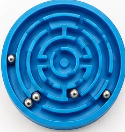
- Circular pathway maze with concentric paths to a central target
- Minimum six small steel balls
- Raised rim helps retain the playing pieces
- Supports concentration, spatial awareness and hand-eye coordination
2
What Students Learn
Develop visual tracking, directional control, planning, patience, sequencing and simple strategy.
Problem solving, concentration, spatial awareness and hand-eye coordination are practised.
Children develop visual tracking, directional sense, steady control and patience.
Planning introduces sequencing, prediction and simple strategy.
Pair and group play reinforces turn-taking and rule following.
3
How to Teach It
The complete illustrated Teacher Guide — including a full step-by-step side guide — is available as a downloadable PDF above.
Activity: Guide the Ball to the Centre
1
Start outside
Place one ball at the outer starting area.
2
Study the path
Ask the child to study the pathway before moving.
3
Tilt gently
Tilt the maze gently so the ball follows the path.
4
Predict next
Pause and ask the child to predict the next movement.
5
Reach the centre
Continue until the ball reaches the centre.
6
Control, not speed
Repeat and challenge the child to improve control rather than speed.
7
Take turns
Rotate turns and ask children to describe their strategy.
4
Teaching Method & Classroom Activity
Suggested Teacher Prompts
Which direction should we move?
Where will the ball go next?
What changed when you tilted the board more?
Can you reach the centre with fewer corrections?
Duration & Setup
- Duration: 10 – 15 minutes
- Preparation: Place the maze on a stable, flat surface. Start with one ball.
- Group size: Whole class, small group or individual, as suited to the activity above.
5
Learning Outcomes
Problem solving, concentration, spatial awareness and hand-eye coordination are practised.
Children develop visual tracking, directional sense, steady control and patience.
Planning introduces sequencing, prediction and simple strategy.
Pair and group play reinforces turn-taking and rule following.
6
Product Features
- Circular pathway maze with concentric paths to a central target
- Minimum six small steel balls
- Raised rim helps retain the playing pieces
- Supports concentration, spatial awareness and hand-eye coordination
7
Teacher Guide — Quick Reference
Quick Assessment
- Child predicts a direction before moving.
- Child adjusts movement after observing the ball.
- Child follows turn-taking rules.
Safety and Care
- Use on a flat surface.
- Steel balls are small; supervise closely and keep them away from mouths.
- Count the balls before and after play.